Thread forming · one feature, three different tools
Molded Threads: Bump-Off, Split Cores or Unscrewing
A thread on a plastic part is not a drawing detail. It decides how the part leaves the mold, and that decision is set by two things: how flexible the resin is, and how many turns are engaged.
Threads are the feature that most often turns a simple part into a three-slide tool, and the question is usually asked too late — after the steel is ordered. It does not have to be. There are only three ways a thread can be molded, and each of them puts the cost somewhere different: in the part, in the tool area, or in the cycle.
The three methods, and what each one costs
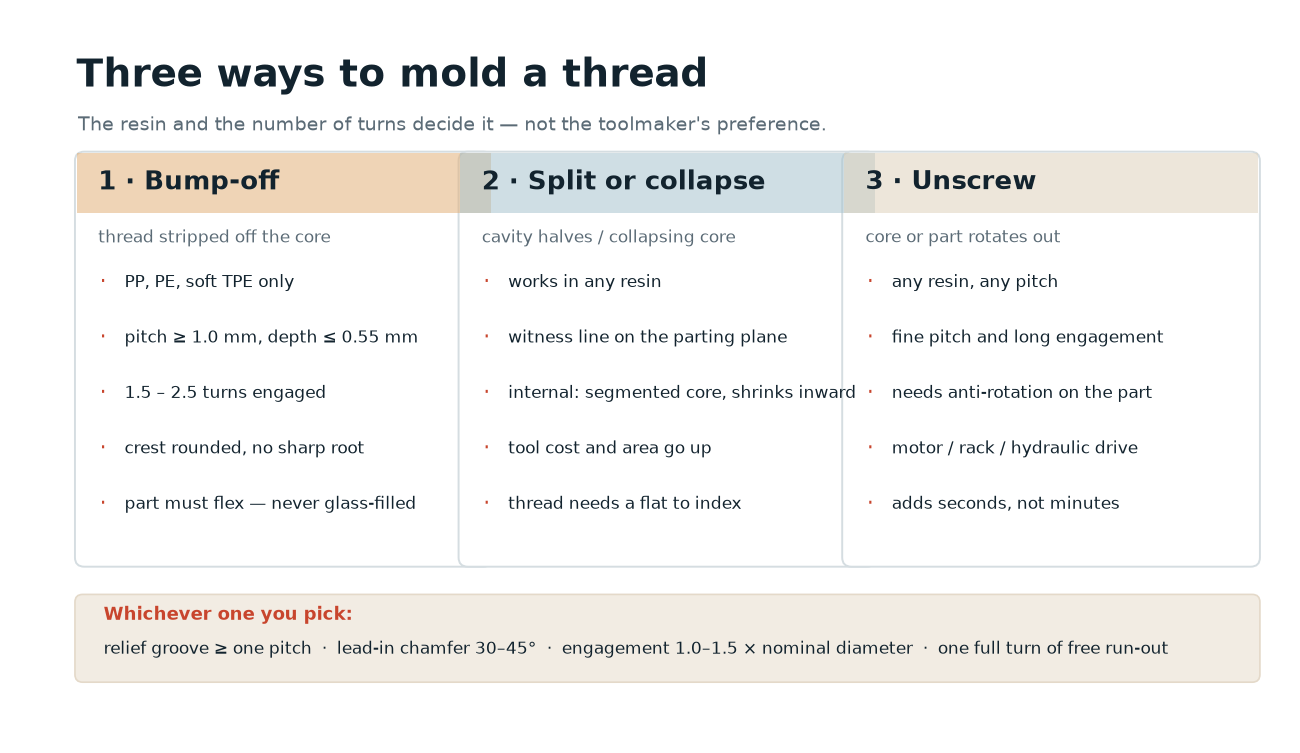
Bump-off forces the part over the thread as it ejects. Split and collapsing cores open or shrink away from the thread before ejection. Unscrewing rotates the core or the part, so the thread is unwound instead of forced.
| Method | How the thread is formed | Where you see it | Where the cost lands |
|---|---|---|---|
| Bump-off (strip) | Part flexes over a fixed core on ejection | Nothing — the thread is continuous | Part stress; limited to soft resins and short threads |
| Split halves | Two cavity blocks part on the thread axis | A witness line along the split, one or two places | Tool area, cams and wear surfaces |
| Collapsing core | Segmented core collapses inward, then ejects | Short axial witness lines between segments | Tool complexity, core maintenance |
| Unscrewing | Core or part rotates out, one turn at a time | Nothing — with a correct start and run-out | Cycle time and drive hardware |
Bump-off works until the part stops flexing
Stripping is the cheapest thread there is, because it costs nothing in the tool: no slides, no drive, no extra cycle time. It relies entirely on the part deforming elastically as it is pushed over the thread and then snapping back to shape. The classic example is a bottle cap — two turns of a coarse, rounded thread, stripped off a fixed core at every cycle, millions of times.
What makes it work is the combination of a soft resin, a shallow thread and a short engagement. Polypropylene, polyethylene and soft TPEs recover well. ABS, PS, PC and anything glass-filled do not: instead of stretching they yield at the thread root, and the crack appears either on the line or a week later at the customer.
- Resin: PP, LDPE/HDPE, soft TPE. Not PC, PS, SAN, nor any glass- or mineral-filled grade.
- Thread depth: roughly 0.5 mm per side or less; pitch 1.0 mm and coarser.
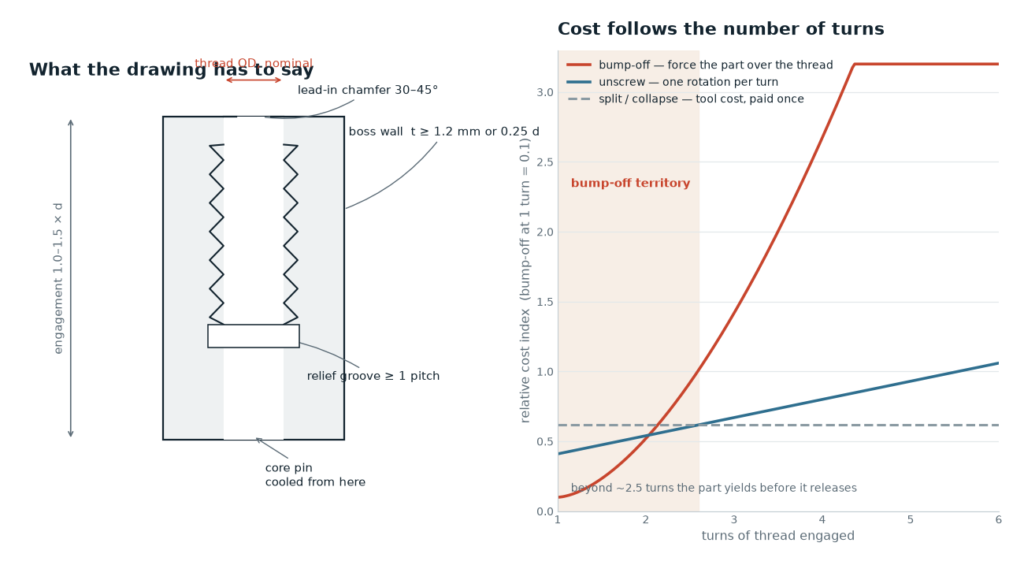
- Engagement: 1.5 to 2.5 turns. Past that the force needed rises faster than the resin can take.
- Profile: rounded crest and root, no sharp corners — every sharp edge is a crack starter.
- Part: thin, flexible walls behind the thread. A rigid boss around a stripped thread is a split boss.
Split and collapsing cores: pay once in the tool
When the thread is on the outside, the usual answer is to split the cavity into two halves that open sideways before ejection — a side-action tool built around the thread. It works in any resin, holds a sharp, fully formed thread, and needs no unscrewing motion — but it leaves a witness line where the halves meet, and on a visible part that line is a design decision, not a toolmaking detail. Two splits are common on caps; more than that and the tool starts to fight itself for space.
Internal threads are handled by a collapsing core: a core made of segments that cam inward, clearing the thread before the part is pushed off. It leaves short axial lines between the segments and needs a proper cam angle, hard wear surfaces and regular maintenance, but it opens internal threads in engineering resins that could never be stripped.
Unscrewing: fine pitch, long engagement, engineering resins
Unscrewing is the method that looks expensive and often is not. The core rotates out of the part — or the part rotates off a fixed core — one turn at a time, driven by a motor, a rack and pinion, or a hydraulic drive. Because nothing is forced, the thread can be fine, deep, long, and in any resin, including glass-filled nylon.
Two things have to be designed in from the start. First, the part needs an anti-rotation feature — a flat, a rib, a hex, a textured band — or it simply spins with the core. Second, the thread needs a clean start and a run-out, so the core begins and finishes its rotation without dragging. The cycle cost is real but predictable: one rotation per engaged turn, so four turns cost roughly four turns of rotation on every cycle.
What the drawing has to carry
Most thread problems at T1 are drawing problems: the tool was built to an assumption. A molded thread needs more information than a tapped hole in metal, because the tool has to reproduce the profile exactly and then get out of it.
- Nominal diameter, pitch and thread standard — metric coarse or fine, UNC/UNF, buttress, round.
- Class or fit, and whether the thread is measured with a gauge or only checked functionally.
- Engagement length: 1.0 to 1.5 × nominal diameter is the usual working range for a plastic thread.
- Relief groove at the thread end, at least one pitch wide — the run-out has to land somewhere.
- Lead-in chamfer of 30° to 45° at the entry, so the mating part starts square.
- Thread start position, and whether the thread may cross the parting line.
- A flat or feature for anti-rotation if the tool will unscrew.
The boss behind the thread matters as much as the thread
A thread concentrates stress at its root, so the wall around it does the real work. As a starting point, the boss wall should be at least 1.2 mm or roughly a quarter of the nominal diameter, whichever is larger, with a fillet at the base rather than a sharp corner. Where the boss meets a visible face, the mass of plastic behind it is what produces the sink mark on the other side — coring the boss, or reducing its wall to match the nominal wall, removes the sink before it exists.
Cooling deserves a note too. A solid core pin inside a threaded boss is a heat trap: if it cannot be cooled, the thread runs hot, shrinks more, and the gauge that passed at T1 stops passing at T3. A bubbler or a baffle inside the pin is usually enough.
Molded thread, or a metal insert?
A molded thread is the right answer for closures, low-load fastening and anything assembled once. It is the wrong answer where the joint is opened repeatedly, where torque is high, or where the screw is metal and the load path has to stay metal: there, a molded-in insert keeps the strength and gives a metal thread that survives service. The trade is cost and a slightly longer cycle, not quality — the two are for different jobs, and mixing them up is how parts come back.
How a thread gets checked
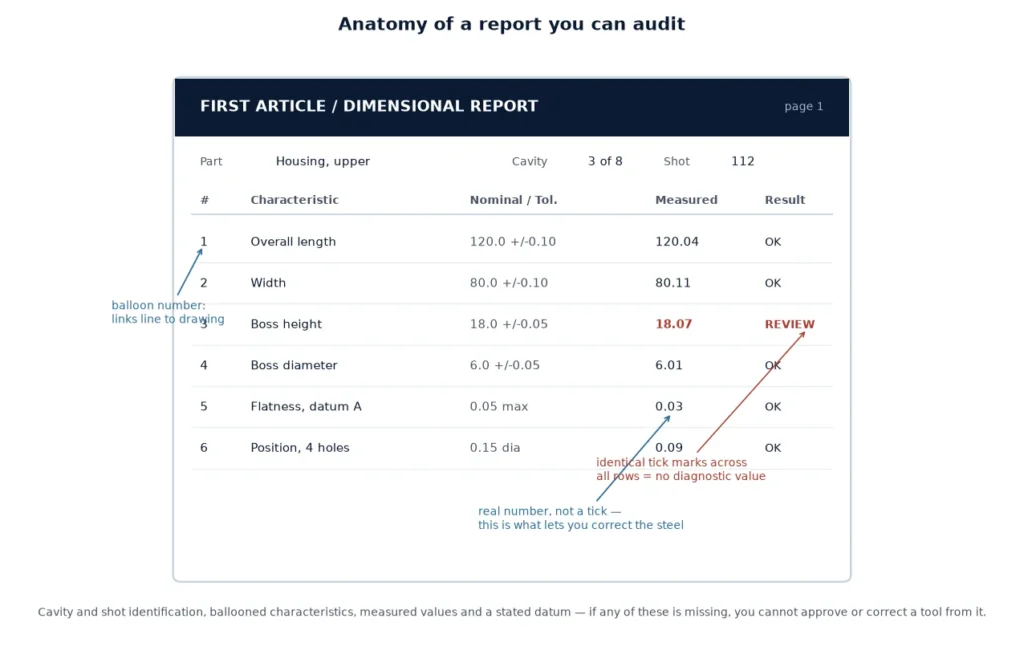
A thread is a functional feature, so it is checked functionally as well as dimensionally. GO/NO-GO ring and plug gauges confirm the profile; a first-article measurement over wires or on an optical comparator confirms the pitch diameter; and a torque test with the real mating part confirms that the joint holds what the drawing asked for. On an unscrewing tool, the first article should also be checked for a clean start — a dragged first thread is a tool timing issue, not a part issue.
What to send with the RFQ
- The 3D model plus a 2D drawing that states the thread standard, class and engagement.
- The resin, and whether it is filled — this alone can decide the method.
- The mating part, or its thread specification, if the joint has to seal or hold torque.
- Whether the thread is visible, and whether a witness line is acceptable on it.
- The assembly torque and the number of times the joint will be opened.
Send those five things and the thread method is a decision that can be made in the quote, with the tool cost attached to it. Send a model with a cosmetic thread and no notes, and the method gets decided by whoever builds the tool — which is how parts arrive with a witness line nobody wanted, or with a thread that cracks in the field.
Frequently asked questions
Can a thread be molded without a side action?
Yes, if the resin is soft and the engagement is short. Bump-off threads — polypropylene and polyethylene caps being the standard example — are stripped off a fixed core with no side action at all. The limits are roughly 0.5 mm of thread depth, a pitch of 1 mm or coarser, and 1.5 to 2.5 turns engaged. A rigid engineering resin or a glass-filled grade will crack at the root instead of flexing.
I need an M6 internal thread in ABS. Strip or unscrew?
Unscrew, or a collapsing core. An M6 coarse thread is far too deep to strip in ABS, and a collapsing core in a 6 mm bore leaves very little room for the segments. Unscrewing is the usual answer: the core rotates out, the part needs a flat or rib to stop it turning, and the cycle grows by roughly one rotation per engaged turn.
Does a molded thread need a relief groove?
It needs somewhere for the thread to end. A relief groove at least one pitch wide gives the tool a clean run-out and stops the last thread from being partial and ragged. Without it, the thread either runs into a shoulder and drags, or ends in a feathered edge that will not accept the mating part.
Molded thread or metal insert?
Molded threads suit closures, light fastening and joints assembled once or twice. Inserts suit repeated assembly, high torque, and any joint where the load path should stay metal. The insert costs more per part and adds a step, and it is still the right choice when the screw is expected to come out and go back in many times.
Will a molded thread seal?
A plain thread does not seal; a thread plus a proper sealing face does. On caps, sealing comes from the land or the plug against the bore, not from the thread flanks, and the thread’s job is to hold that face under load. If the joint has to hold pressure, say so in the RFQ — it changes the wall, the concentricity and the way the thread is checked.
How much cycle time does an unscrewing mold add?
Roughly the time of one rotation per engaged turn, plus the time to reverse and re-index the core. On a four-turn thread that is a few seconds per cycle, which matters on a high-volume part and is irrelevant on a low-volume technical one. It is one of the reasons the number of turns, not the diameter, is the figure to watch.
Have a thread that is causing trouble?
Send the part model, the resin and the mating thread specification. We will tell you which of the three methods fits, what it does to the tool, and what has to change on the drawing before the steel is cut.