Tooling Economics
What Drives the Cost of an Injection Mold? Seven Factors Buyers Can Check
Two quotations for the same part can differ by 40%. Almost always for these seven reasons — and six of them are visible on the quotation itself.
Short answer: an injection mold costs what it costs because of seven things — the geometry of the part, the number of cavities in the tool, the grade and hardness of the steel, the mold structure (two-plate, three-plate, hot runner, slides), the surface finish and texture, the tolerances the part has to hold, and how much validation and documentation you want before the tool ships. Move any one of those and the number moves with it.
That is why a mould quotation is not a single figure you can compare like a bearing price. It is a set of engineering choices with a number attached. The useful question is never “why is yours higher”, it is “which choices are different”. Below are the seven that decide almost all of it, plus the checklist we use when a buyer asks us to explain a gap between two offers.
1. Part geometry, or how much the tool has to do
Before any steel is cut, the part drawing already decides a large share of the tool. A flat housing with uniform 2 mm walls, generous draft and one parting line is a straightforward tool. The same envelope with six undercuts, a 0.6 mm rib grid, a lens-quality surface on one face and a thread that cannot be stripped is a different project.
What raises the number here: undercuts that need slides, lifters or collapsible cores; deep thin cores that need inserts or beryllium-copper; wall thickness transitions that would sink without extra cooling; gates that cannot be placed on a hidden face; and any feature that forces the parting line onto a visible surface.
This is where a design-for-manufacture review earns its place. Moving one rib, adding a degree of draft or shifting a gate can remove a slide from the tool — worth more than any negotiation on hourly rates. A quotation without a DFM note is a price on a drawing nobody has questioned.
2. Cavity count
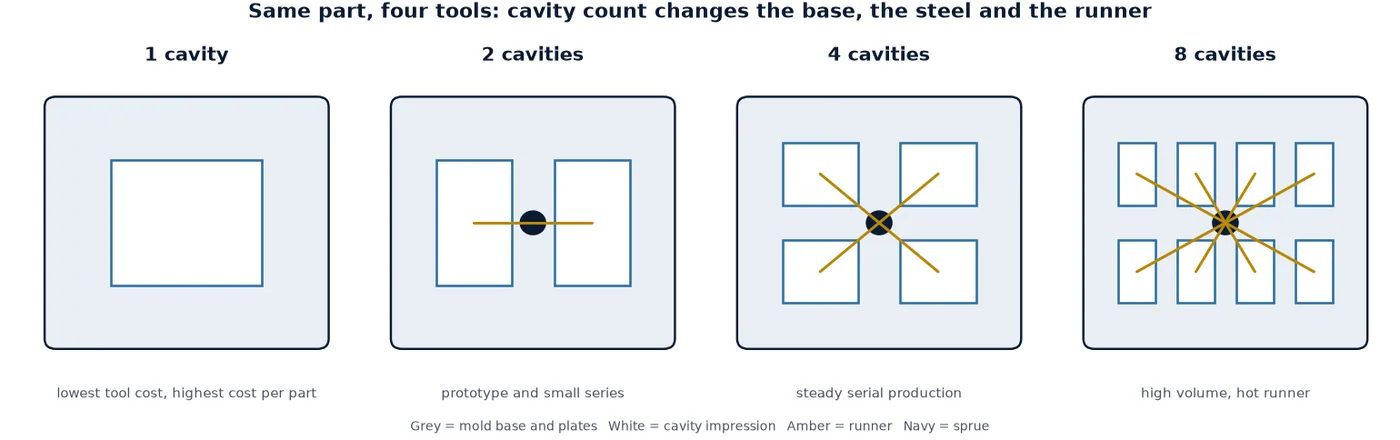
Cavity count is the single biggest lever, because it multiplies everything else: a larger base, more steel, more machining hours, a bigger hot runner and a larger press to run it.
It is also the lever buyers most often get wrong, because the arithmetic only works above a break-even volume. A single-cavity tool is cheapest to build and most expensive per part. An eight-cavity tool costs more to build, but spreads that cost over eight parts per cycle. Between those two points there is a volume below which the extra cavities are simply never filled, and you have paid for steel you do not use.
- Prototype or low volume, or several variants of the same family: one or two cavities, sometimes a family tool with interchangeable inserts.
- Steady serial production with a stable forecast: four to eight cavities is the usual balance for small and mid-size parts.
- High volume, small part, long program: sixteen cavities and above only make sense with a hot runner and a press that can run it.
When comparing offers, check the cavity layout as well as the count: a 2+2 family layout and a straight four-cavity layout both say “4” and are not the same tool.
3. Mold steel and hardness
Steel is where two quotations for the “same” tool quietly diverge. The grade decides how the cavity is cut, how it polishes, how it survives an abrasive or corrosive resin, and how many shots it lasts.
| Steel | Hardness | Chosen when |
|---|---|---|
| P20 / 1.2311 | about 28-32 HRC, pre-hardened | General purpose parts in ABS, PP, PE, PS; moderate volumes; the economical default. |
| 718H / 1.2738 | about 33-36 HRC, pre-hardened | Larger cavities, better polishability, slightly longer life than P20 for the same machining route. |
| S136 / 1.2083 | about 30 HRC pre-hardened, or 48-52 HRC after hardening | Transparent parts, optical surfaces, medical and food-contact parts, PVC and other corrosive melts. |
| NAK80 | about 38-41 HRC, pre-hardened | Fine textures and high-gloss cosmetic surfaces where polishing risk must stay low. |
| H13 / 1.2344 | 48-52 HRC after hardening | Glass-filled or highly abrasive resins, very high volumes, long-run tooling. |
Two things to check on a quotation: whether the steel is named at all — “imported mold steel” is not a specification — and whether the hardness is stated for the cavity and core inserts, not just the base. Glass-filled polyamide in a 30 HRC cavity erodes the gate area long before the tool reaches nominal life, and it shows up as a flash line at the gate, not as a warranty claim.
4. Mold structure
Structure is the part of the quotation buyers read least and suppliers vary most. A two-plate tool with a cold runner is the baseline. Everything above that adds cost, and each addition should be justified by the part or the volume.
- Three-plate: allows a central gate on a part where a side gate would leave a mark on a visible face. Adds a second opening stroke and more plate work.
- Hot runner: removes runner scrap and shortens cycle, but adds a manifold, drops, heaters, thermocouples and a controller. It is a maintenance item for the life of the tool, not a one-time purchase.
- Slides, lifters, collapsible cores: each moving element is machining, fitting, guiding, wear surfaces — and a potential leak or a potential jam.
- Ejection: pins are cheapest, a stripper plate or sleeve is gentler on thin walls and cosmetic surfaces.
- Base standard: a branded base (DME, Hasco) costs more than one machined locally, and buys interchangeable components later.
- Two-shot: a rotating platen changes the tool architecture, not just the cavity.
A useful question for the supplier: which elements of this structure are driven by my part, and which are driven by your standard practice? The answer usually explains a big part of a price gap.
5. Surface finish and texture
Finish is specified as a grade, not as an adjective. The SPI mould finish standard runs from A1 (high polish, optical) through A2-A3, B1-B3, C1-C3 to D1-D3 (textured). Each step changes how much hand polishing the cavity needs, and polishing is skilled hours that cannot be automated away.
A polished A2 surface on a deep rib is genuinely difficult; the same grade on a flat plate is routine. Textures add a layer: the grain must etch consistently in every cavity, and deep grains need draft the part drawing may not have. Applied after the tool is built, the draft is already cut — and a texture that pulls shows as drag marks on every part.
Practical advice: state the finish grade and the texture reference on the purchase order, and ask for a sample plaque or a photographed coupon from the actual cavity before the tool is accepted. “Matte finish” means nothing across two suppliers, and it means nothing in a dispute.
6. Tolerances and process capability
Every dimension you tighten is a machining decision, an inspection decision and a process decision at the same time. A tool that has to hold a 0.02 mm position on three features is built and checked differently from one holding 0.1 mm on the same features.
Plastic parts also move after ejection. Tolerance class, gate position, cooling and packing decide whether a dimension is stable, so a tight tolerance on a warping feature is not solved by machining accuracy — it is solved by cooling and gate design, which is tool work.
The clean way to specify this is a tolerance standard rather than a drawing full of tight numbers: DIN 16742 classes for plastic parts are widely understood, and they force the conversation onto which dimensions actually matter. Ask which dimensions will appear on the dimensional report. If the answer is “all of them”, ask which ones will be capable, not just conforming — those are different things.
7. Validation, documentation and tool life
The last group is invisible on a drawing but visible on a quotation: what happens between first shot and handover.
- Trial scope: a T1 with photographs, or a T1 with a full dimensional report, first-article inspection and a capability study.
- Documentation: material certificates, steel certificates, hardness reports, mold flow, a maintenance manual, a spare-parts list, a mold drawing set.
- Tool life target: 100,000 shots and 1,000,000 shots are not the same tool — different steel, different wear surfaces, different spare inserts.
- Spares and serviceability: a spare cavity insert, standard water fittings, quick couplings, a lifting arrangement that matches your crane.
This is the part that most often disappears when a buyer pushes for a lower figure, and the part that decides what the tool costs over five years rather than on approval day.
The seven factors on one page
| Factor | What pushes cost up | What you can decide before approving |
|---|---|---|
| Part geometry | Undercuts, deep thin cores, no draft, gates on visible faces | Accept a DFM change: one slide removed is a real saving |
| Cavity count | More cavities, family layouts, unbalanced runners | Match cavities to realistic volume, not to the best-case forecast |
| Mold steel | Hardened H13, S136 for optical or corrosive, large blocks | Name the grade and the hardness for cavity and core |
| Structure | Hot runner, three-plate, slides, lifters, branded base | Keep moving elements to what the part genuinely needs |
| Finish | High polish, deep texture, polish on deep ribs | Specify the SPI grade and the texture reference |
| Tolerance | Many tight dimensions, capability studies on all of them | Pick the critical dimensions, use DIN 16742 classes elsewhere |
| Validation | FAI, capability, PPAP-level documentation, spares, long tool life | Decide the handover package before the tool is built, not after |
How to compare two mould quotations without getting fooled
When two offers for the same part differ, work through this list in order. In our experience the gap is explained by items three and eight far more often than by labour rates.
- Cavity count and layout — is it the same tool, or the same number with a different arrangement?
- Steel grade, steelmaker and hardness for cavity and core.
- Mold base: standard brand, plate thickness, or a locally machined base.
- Hot runner: brand, number of drops, controller included or not.
- Moving elements: how many slides, lifters and collapsible cores.
- Finish: SPI grade per surface, texture reference, who pays for etching.
- Trial and documentation scope: how many trials, what reports, what certificates.
- Tool life target, warranty and spare parts.
If a quotation cannot answer items one to four in writing, the price is not comparable yet — not as a negotiating position, just as a fact about what a mould is.
What we put in a mould quotation
Our own quotations are built on a design review rather than a drawing alone: a mold design and DFM step before steel is ordered, a cavity layout you can see, the steel and hardness named, and a trial plan that states what the inspection package will contain. Where the part runs into production, the same tool feeds our own injection molding floor, which is why structure and cooling get argued about early rather than at T1.
If you want a second opinion on a quotation you already have, send the drawing and the offer: we will tell you which of the seven factors are behind the number, and whether the tool being described is the tool you asked for. Send a drawing and we will come back with a DFM note first.
Frequently asked questions
Does a higher cavity count always lower the cost per part?
No. It lowers machine time per part, but only once volume is high enough to fill every cavity. Below that break-even point you have paid for steel, a bigger base and a bigger press that sit idle, and cost per part is worse than a two-cavity tool.
Is a hot runner always the faster option?
It shortens cycle and removes runner scrap, and at high volume with small parts it usually pays for itself. It also adds a manifold, heaters, thermocouples and a controller to maintain, and it needs a clean, consistent resin. For low volume or resins sensitive to residence time, a cold runner is often the better engineering choice.
Can I start with one cavity and add cavities later?
Rarely. The mold base, the steel block and the cooling layout are cut for a fixed cavity count. What you can do is design the part and the base so that a family tool or interchangeable inserts are possible, which is a decision to take at the design review, not after the tool exists.
Why can the same part drawing get offers that differ by 40 percent?
Because the offers are usually not for the same tool. Differences in cavity count, steel grade, hot runner brand, the number of slides, texture work and the validation package account for most of it. Labour rates explain far less than buyers assume.
My part has an undercut. Does that mean slides?
Not always. An undercut can sometimes be handled by a lifter, a collapsible core, a bump-off, or a small design change that removes it entirely. Each option has a different cost and maintenance profile — exactly the kind of choice a DFM review should put in front of you.
How much does a mould cost?
We deliberately do not publish figures, because the number depends on the seven factors above and a published figure would only be accurate for one part. Send the drawing, the resin, the annual volume and the finish requirement, and the quotation will name the steel, the structure and the inspection scope so you can compare it properly.
Send a drawing, get a DFM note back
Tell us the resin, the annual volume and the surface requirement. We will reply with a cavity proposal, the steel we would use and the inspection package, so the number on the quotation has something behind it.