Feed systems
Hot Runner vs Cold Runner: How the Feed System Changes Scrap, Cycle and Part Quality
The runner is the cheapest-looking part of the mold and the one that decides the most: scrap rate, colour changes, gate marks, cycle time and how much maintenance the tool asks for. Here is how we choose between a cold and a hot runner, in the order the decision actually gets made.
The short answer
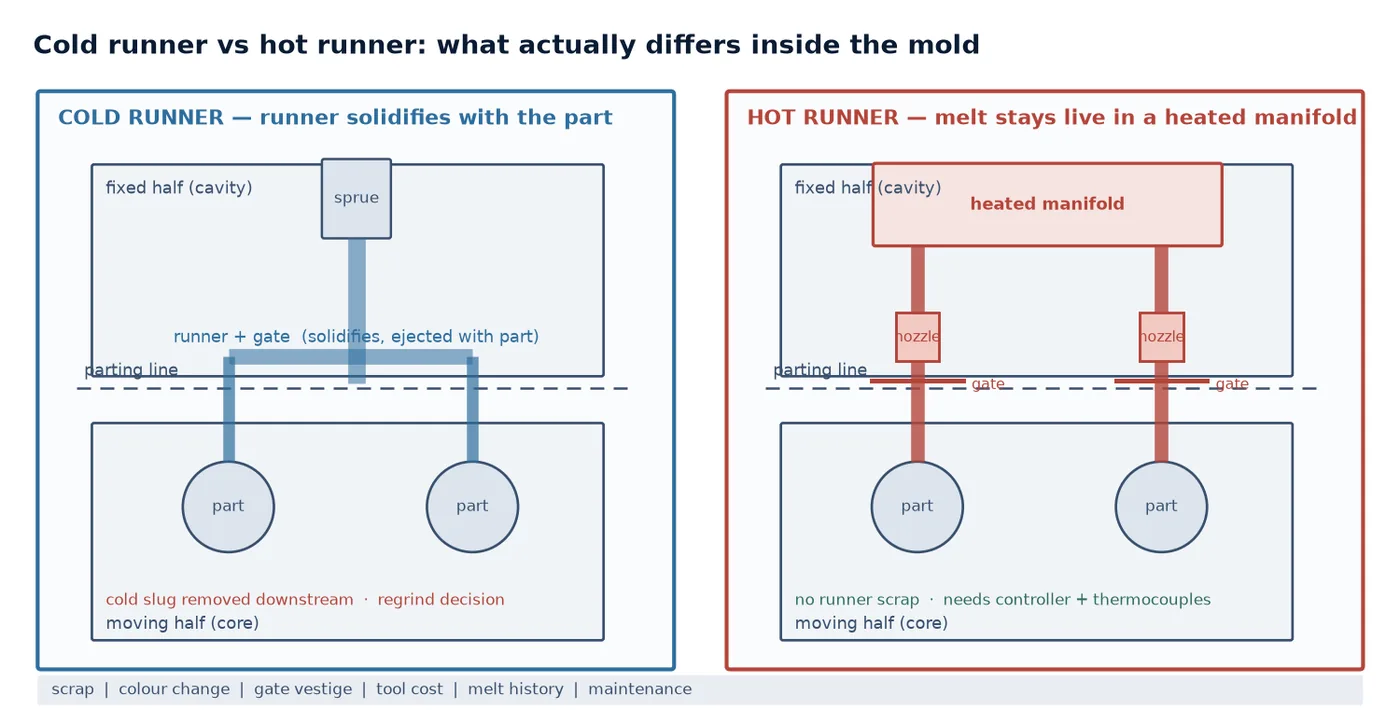
A cold runner is a mold where the melt in the sprue and runner solidifies together with the part and gets ejected with it. A hot runner keeps the melt live in a heated manifold and drops it straight into the cavity through a heated nozzle, so there is no runner to eject and no runner to throw away. Neither is the better tool. They fail in different places, and the choice is usually made by volume, material and cosmetics — in that order.
Most of the disagreements we see in quotation reviews come from treating the runner as a detail to be decided after the cavity layout. It is not a detail. It sets the scrap rate, the allowable colour-change discipline, the gate vestige the customer will inspect, and how many extra parts the tool needs before it pays for itself. Deciding it late means redesigning the mold base.
What a cold runner costs after the tool is paid for
A cold runner is cheap to build and expensive to run. Every shot produces a runner that is either scrapped or reground. On a single-cavity tool with a short sprue the loss can be small; on an eight-cavity tool with a long runner it becomes a visible percentage of every kilogram of resin you buy. That is why volume and cavitation matter more than the tool price itself: the runner cost repeats for the life of the program, and the tool cost happens once.
- Scrap and regrind: the runner is either sold as scrap or ground and blended back. Regrind changes melt flow, colour and mechanical values, so each material has a practical limit on how much you can return.
- Cycle: the runner has to cool enough to eject, which adds time on thick sections, and adds mass the machine has to carry.
- Colour change: a cold runner is usually the faster system to purge when you swap colours, because you are purging the barrel and a simple flow path.
- Gate vestige: the gate breaks away or is trimmed, so the mark sits where the gate was cut. Cosmetic rules decide whether that is acceptable.
- Two-plate simplicity: fewer heaters, fewer thermocouples, no controller, and a maintenance routine a tool room can handle without special training.
What a hot runner costs before the first good part
A hot runner moves complexity from the resin bill into the tool. You pay for a manifold, nozzles, heaters, thermocouples, a controller and the engineering that balances the melt distribution. The part usually arrives with no runner attached, gate quality is more repeatable, and the cycle can shorten on thick walls because the feed section no longer has to freeze. Those gains are real, and they are also conditional: a badly balanced manifold or a nozzle with the wrong tip will give you scrap with a much higher hourly cost than a cold runner ever would.
- Temperature control is now part of production: zones drift, thermocouples fail, heaters burn out. Without a disciplined controller routine the tool starts producing suspect parts quietly.
- Start-up and shut-down need a procedure. Heating profiles, soak time and purging are part of the process sheet, not optional habits.
- Maintenance asks for spare nozzles and someone who can change a heater without damaging the manifold.
- Gate vestige is different, not automatically better: a hot tip leaves a small mark that may sit proud or be visible on a textured surface, and valve gates leave a small circle that has to be placed where the customer allows it.
- Some materials and some colours are a poor fit — heat-sensitive resins, and families where a residence time in the manifold degrades the melt.
Side-by-side comparison
| Decision factor | Cold runner | Hot runner |
|---|---|---|
| Tool cost and complexity | Lower: plate, sprue, runner, gate | Higher: manifold, nozzles, controller, wiring |
| Runner scrap per shot | Produced every shot, scrapped or reground | None in normal running |
| Effect on regrind policy | Must be planned and documented | Removes the runner stream entirely |
| Colour change | Fast purge, simple flow path | Needs purging through nozzles; dead spots matter |
| Gate vestige | Trimmed gate mark at the cut | Small tip mark or valve-gate circle, position-critical |
| Cycle time on thick walls | Runner adds cooling and carries mass | Feed stays open; can shorten the cycle |
| Process window | Wider, more forgiving | Narrower; temperature discipline is mandatory |
| Maintenance skill | Standard tool room work | Heaters, thermocouples, controller, spare nozzles |
| Best fit | Low to mid volume, prototypes, frequent changes | High volume, tight cosmetics, long runs |
Gate position is a design decision, not a runner decision
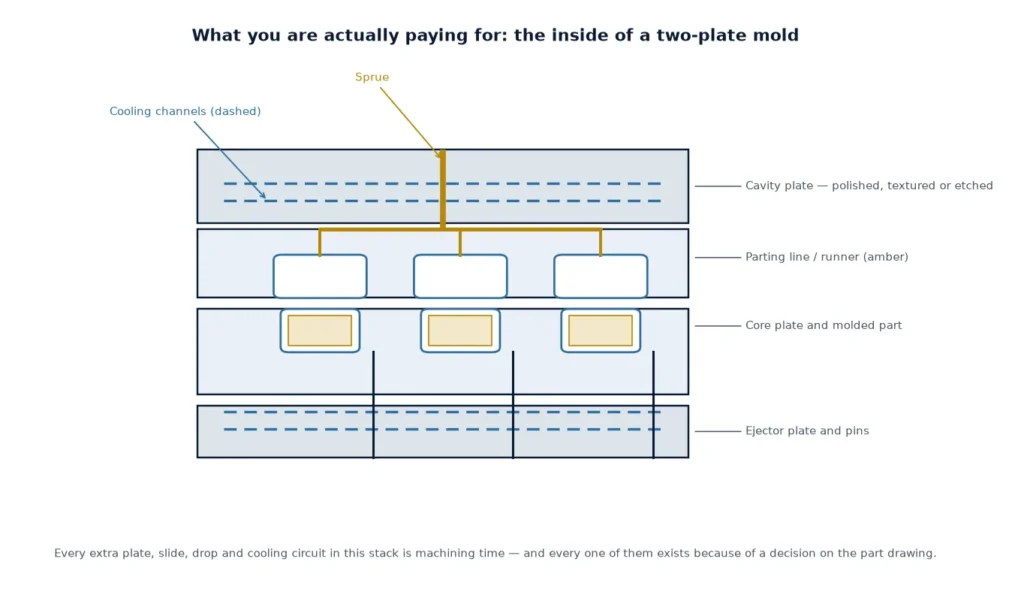
Where the gate lands decides which feed system you are allowed to use. If the part has a visible cosmetic face, the gate has to hide on a non-visible surface, feed into a rib, or sit behind a feature the customer will not inspect. A hot tip can feed almost anywhere without leaving a runner, which is why cosmetic parts push teams towards a hot runner. A cold runner with a submarine or tunnel gate can hide the mark just as well in many geometries, at a fraction of the tool complexity — as long as the gate can be cut cleanly and the runner can be ejected without marking the part.
In practice we sketch the gate first, then pick the feed system that can deliver it, then check whether the runner volume or the manifold can be packaged inside the mold base the customer’s press can take. Doing it in the other order is how a mold ends up with a manifold that does not fit or a cold runner that cannot be ejected.
Material and colour constraints that override volume
Volume says hot runner; the material sometimes says no. Heat-sensitive grades degrade when they sit in a manifold at temperature, so residence time and zone design have to be checked against the resin datasheet rather than assumed. Glass-filled grades wear nozzles and gates faster, which changes maintenance frequency rather than feasibility. And colour is its own project: light colours following dark ones in a manifold need a purge routine that is written down, because dead spots in a manifold release old colour for dozens of shots.
For parts that must be optically clean, or where a customer runs many short colour batches, a cold runner with good gating is often the calmer choice: the purge is visible, the flow path is short, and there is no hidden volume holding yesterday’s colour.
The selection sequence we use
We run the same five questions on every tool, in this order, and stop at the first one that decides it. Volume first, because it sets the economics. Material second, because it can veto the answer. Cosmetics third, because gate vestige rules eliminate options. Colour changes fourth, because a frequent-swap program punishes a manifold. Downtime tolerance last, because a hot runner adds a control system the customer’s team has to own.
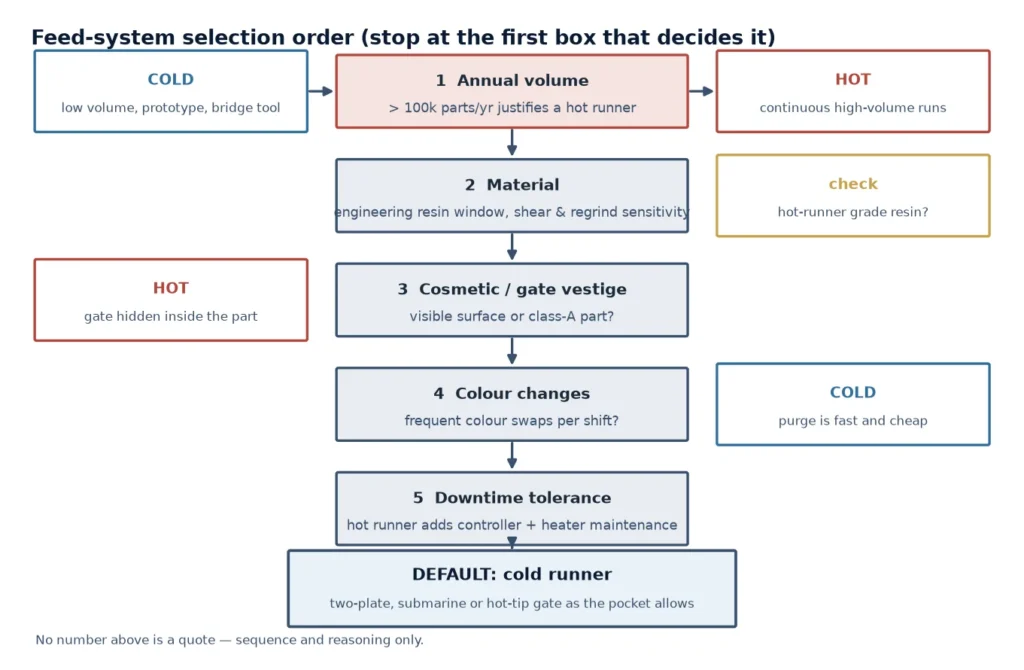
If nothing decides it, the default is a cold runner. That default is deliberate: on an undecided program a simpler tool is easier to prove out, easier to maintain and easier to change when the customer’s volumes move. A hot runner should be chosen because a specific requirement demands it, not because it sounds more advanced in a review meeting.
Hybrids worth knowing about
The choice is not binary. An insulated runner leaves a large runner that stays molten under its own skin and is often used on thick parts in forgiving materials. A hot-tip or hot-nozzle arrangement can feed specific cavities while others stay on a cold runner. Sequential valve gating lets you control fill front position on large parts and can remove weld lines — at the cost of a controller and a sequence that must be validated. Each of these trades tool complexity for part quality in a specific place, and each one has to be argued from the part, not from a preference.
For multi-cavity family tools the honest comparison is rarely hot versus cold as a whole. It is which cavities earn a heated drop and which ones are better served by a balanced cold runner.
What we ask before quoting a feed system
Most feed-system mistakes are information mistakes, not engineering mistakes. These are the things we need before we can commit to a runner layout:
- Annual volume and expected program life, plus the batch pattern — one long run or many short ones.
- Resin grade and datasheet, including any regrind limit the customer already works to.
- Which surfaces are cosmetic, and where a gate mark is allowed to sit.
- Press platen size and the mold height the machine can take, since a manifold needs space.
- Who runs the tool afterwards: a tool room that can service a controller, or one that would rather not.
- The colour-change policy for the life of the part.
If any of those are missing, we say so and hold the runner layout, because guessing volume or cosmetics is exactly how a feed system gets rebuilt after the first trial. The same discipline applies to the rest of the tool: see our notes on cooling circuit design, mold types and inspection equipment, and the plastic injection molding overview for how the process side is set up.
Frequently asked questions
Does a hot runner always shorten the cycle?
No. It removes the runner’s cooling requirement and the mass the clamp carries, which often helps on thick walls. On thin-wall parts where the cycle is dominated by the part itself the gain can be small, and the start-up and soak time for the manifold has to be counted honestly.
Can we add a hot runner to an existing cold-runner mold?
Sometimes, but it is a rebuild rather than an upgrade: the cavity plate gets re-cut for nozzles, the mold base needs room for the manifold, and the press needs a controller. It is usually only worth it when the part is staying in production for years and the runner scrap is measurable.
Is a cold runner acceptable for a cosmetic part?
Often yes, if the gate can be placed on a non-visible surface and cut cleanly — a submarine or tunnel gate can hide the mark. What decides it is where the gate is allowed to sit, not the runner type by itself.
What breaks most often on a hot runner?
Heaters and thermocouples, followed by gate wear on glass-filled materials and damaged nozzle tips from handling. Keeping spares and a documented heater-replacement procedure matters more than the brand of the manifold.
How do colour changes work on a hot runner?
They are a procedure, not an event: a defined purge sequence through every zone, with scrap shots counted until the colour is clean. Manifolds with dead spots take longer, which is why a program that changes colour often leans towards a cold runner.
Send the part data and we will review the feed system with it
Share the 3D model, the resin datasheet, the cosmetic surfaces and the press details. We will come back with the gate layout, the runner option we recommend and the questions that still need an answer before steel is cut.