Tooling metallurgy
Heat Treatment and Surface Treatment for Mold Steel: What Nitriding and PVD Actually Buy You
Two tools cut from the same block of H13 can behave like different materials once one is hardened and nitrided and the other is not. This is the order of operations we use, what each layer on the cavity surface is responsible for, and the four questions that decide between nitriding, PVD and doing neither.
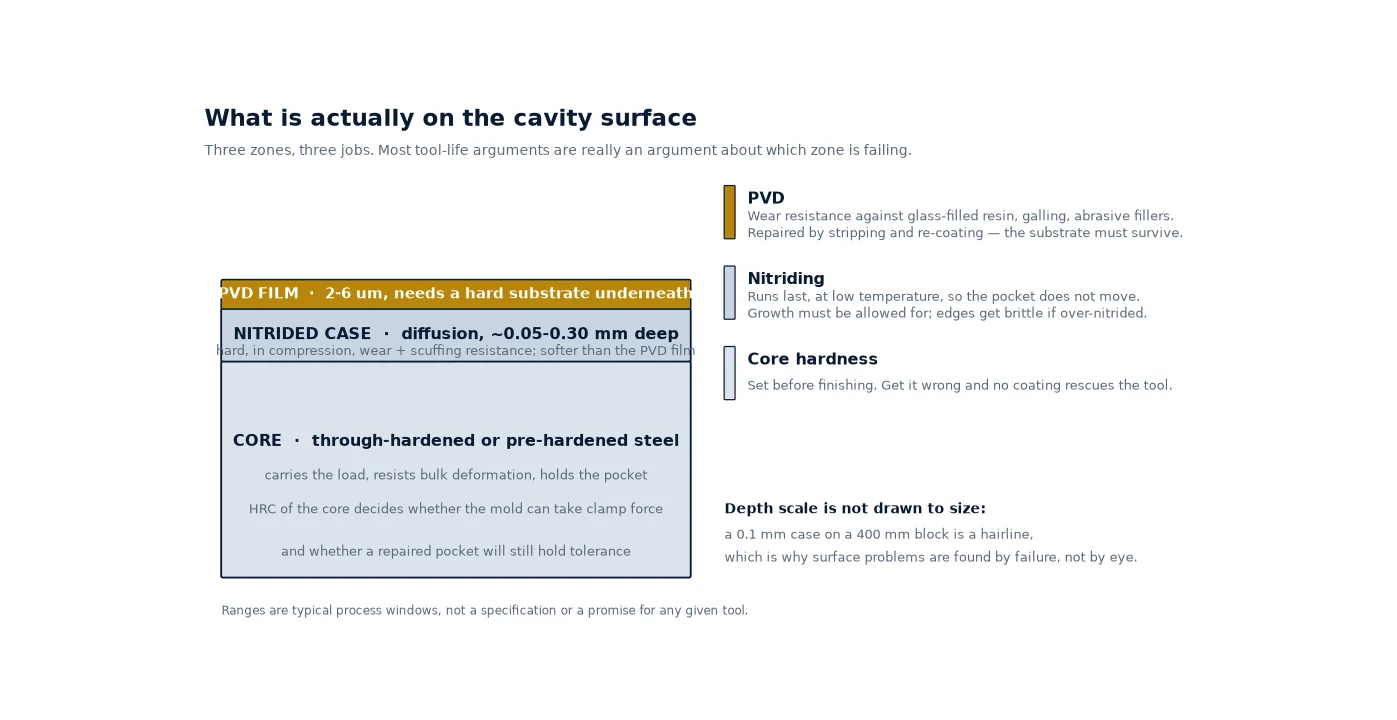
Hardness numbers get quoted in isolation, and that is where most of the confusion starts. A 52 HRC core, a 0.1 mm nitrided case and a 3 µm PVD film are three different answers to three different problems: load, wear and friction. Getting the first one wrong cannot be repaired by the other two.
Start with the steel as it arrives
Pre-hardened plates such as P20 or 718 arrive at roughly 30-34 HRC. They machine well, they do not need a hardening step, and for a large housing or a low-volume tool they are usually the sensible choice. Their limit is wear: a 30 HRC pocket running glass-filled nylon will polish itself away at the gate and on the shut-offs long before the plate cracks.
Annealed H13 (or a stainless grade such as 420) arrives soft, gets fully machined, then is quenched and tempered to 48-54 HRC. You buy hardness and wear resistance, and you pay for it in distortion, in grinding allowance, and in the fact that the heat treater becomes part of your tolerance stack. A deep pocket that is quenched after finishing will move; the only question is how much and in which direction.
There is a middle route that gets asked for often: machine soft, then harden, then finish by EDM or grinding. It works, it costs machining time, and it is the right answer when the pocket geometry needs hardness in the corners rather than on the surface only.
What the core hardness is really doing
The core carries load. Clamp force, injection pressure, ejection and the occasional short shot all push on the pocket, and the substrate has to spring back to the same place every cycle. Below roughly 30 HRC the risk is peening and sink marks around the gate; above roughly 54 HRC the risk moves to cracking at sharp internal corners and to chipping on thin cores.
Toughness is not the opposite of hardness, it is the thing tempering buys. A 54 HRC tool tempered back from 56 HRC behaves better in service than a 56 HRC tool that was never tempered properly, and the difference only shows up as an edge that chips instead of wearing.
Nitriding: a case, not a coating
Nitriding diffuses nitrogen into the surface at a temperature low enough that the pocket does not re-austenitise, typically in the 500-560 °C window over many hours. The result is a hard case roughly 0.05-0.30 mm deep sitting on the core you already hardened. Nothing is added on top, so there is no dimension to subtract afterwards — only growth to allow for.
That is the whole appeal: it goes last, at low temperature, and it turns a wear-prone 48 HRC surface into something that survives abrasive resin without changing the pocket dimensions more than a few microns. On a textured tool it also protects the texture from polishing away at the gate.
- Growth is real. The case expands the surface; allow for it before finishing, not after nitriding.
- Edges get brittle as well as hard. Over-nitrided sharp edges chip, and the chip is bigger than the wear it prevented.
- The white compound layer matters. Where it is unwanted it is removed; where galling is the problem it can be kept.
- Blind holes and water lines are not improved by it. Nitriding is a cavity-side decision.
Nitriding is also the standard answer for a tool that is already in production and wearing: strip, re-nitride, re-polish, and the gate area gets a second life without recutting the pocket. That is often worth more than any change to the original design.
PVD: thin, hard, and entirely dependent on what is underneath
Physical vapour deposition puts a 2-6 µm ceramic film — TiN, TiAlN, CrN, DLC and relatives — on the cavity surface at temperatures low enough for a hardened tool. It is the hardest thing in this article by a wide margin, and it is also the thinnest, which is exactly why it does not fix a soft substrate: a film that thin cannot bridge a pocket that is deforming underneath it.
What PVD genuinely buys is resistance to abrasion and to galling. Glass-filled engineering resins, filled grades with mineral or glass content, and anything that tends to stick and tear on ejection are where the film earns its place. It also reduces friction, which shows up as easier ejection and less scuffing on textured walls.
What it does not buy: dimensional correction, corrosion protection on its own, or a fix for a heat treatment problem. Applied to a substrate that is too soft, it fails by substrate collapse and the failure looks exactly like a coating fault — which is why the argument about coatings is usually an argument about the core.
- Sharp edges and film thickness are enemies. Radius the edge or the film will not cover it.
- Re-coating is a design constraint. A tool that has been welded on, or whose pocket has been polished past the tolerance, may not be a candidate again.
- Masking is a decision, not a detail. Ejector holes, water fittings and shut-off faces usually stay bare.
Chrome and electroless nickel, briefly
Hard chrome plating is an old answer that still works for PVC and other corrosive melts, and for release problems on large, simple surfaces. It builds measurable thickness, so it can restore a worn core — and it also builds on edges, which is where plating problems start. Electroless nickel gives a more even deposit over complex geometry and better corrosion resistance, at the cost of a less hard surface than either nitriding or PVD.
| Treatment | Where it sits | Best at | Watch out for |
|---|---|---|---|
| Through-hardening | Whole block | Load, wear at depth, corner hardness | Distortion after finishing; grinding allowance |
| Nitriding | Case on the surface | Abrasive wear, texture protection, rework of worn tools | Growth, brittle edges, compound layer control |
| PVD film | 2-6 um on top | Abrasion, galling, ejection friction | Needs a hard substrate; thin; re-coating limits |
| Hard chrome | Deposit, tens of um | Corrosion with PVC, release, worn core recovery | Build-up on edges; adhesion on complex shapes |
| Electroless nickel | Even deposit | Corrosion, complex geometry coverage | Softer than nitride or PVD |
The sequence is not a preference
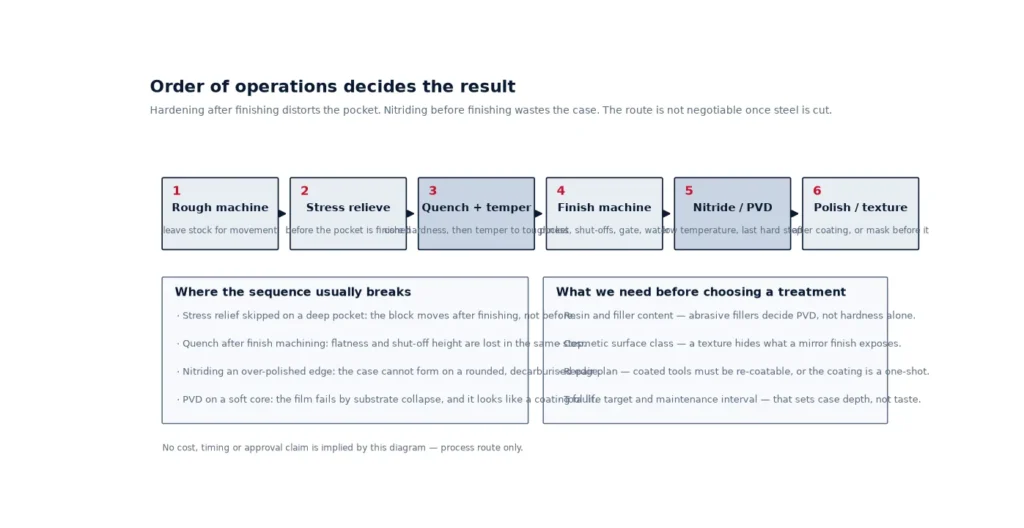
Rough machine with stock for movement, stress relieve before the pocket is finished, quench and temper to the hardness you actually want in service, finish machine, then the low-temperature surface step, then polish or texture — masking whatever must stay bare. Every short cut in that chain moves the error to a later, more expensive operation.
Two practical consequences. First, the decision about nitriding and PVD belongs in the DFM review, not after the tool is built, because both change what the finishing operation has to leave behind. Second, the repair route has to be decided at the same time: a coated tool whose pocket cannot be re-polished is a tool with one life instead of three.
What we ask before recommending a treatment
- Resin and filler content, because abrasive fillers decide the film and the case depth, not the hardness number alone.
- Cosmetic surface class, because a texture hides wear that a mirror finish exposes immediately.
- Expected tool life and the maintenance interval, because that sets case depth far more than taste does.
- Repair and re-coating plan, because a treatment that cannot be repeated is a single-life decision.
Answer those four and the treatment usually chooses itself. If they cannot be answered yet, the honest recommendation is to build the tool with enough stock and the right core hardness, and decide the surface step once the first samples have shown where the wear actually lands.
Two decisions usually move before the surface one, and both are worth settling at the same review: the feed system, covered in our comparison of hot runners and cold runners, and the circuit layout in mold cooling circuit design. Steel, surface and thermal layout are one argument about tool life, and they are cheapest to have together.
Frequently asked questions
Can we nitride a mold that is already in production?
Usually yes, and it is one of the better reasons to choose nitriding in the first place. The tool is stripped, cleaned, re-nitrided at low temperature and re-polished, so the pocket does not need to be recut. What has to be checked first is whether the current dimensions and the existing texture will survive another polishing pass.
Is PVD worth it on a tool that will only run a small batch?
It depends on what is wearing. On an abrasive filled resin the film often pays for itself in gate and shut-off life even on modest volumes; on an unfilled commodity resin running a short batch, a well-made nitrided tool is usually the simpler answer. The film is a wear decision, not a quality badge.
Why did our coating fail after a few thousand shots?
The two common causes are a substrate that was too soft, so the film collapsed with the steel underneath, and an edge that was too sharp for the film to cover. Both look identical in a photograph and both are decided before the coating is applied.
Does nitriding change the part dimensions?
Yes, slightly, and predictably. The case grows the surface by a few microns to a few tens of microns depending on depth, so the allowance belongs in the finishing operation. Tools that were finished to final size and then nitrided are the usual source of a tight shut-off that no longer closes.
Can we combine nitriding and PVD on the same tool?
It is a common combination: the nitrided case gives the film a hard substrate to sit on, and the film handles the abrasion at the gate. The constraint is process order and temperature — the film goes on after the case, and both come after the pocket is finished.
Send the part and resin data and we will review the steel and the surface step together
Share the 3D model, the resin datasheet with filler content, the cosmetic surfaces and the expected production volume. We will come back with the steel grade, the hardness target, whether the pocket needs a case or a film, and the questions that still need an answer before steel is cut.