MOLD ENGINEERING
Mold Steel Selection: P20, 718H, S136 or NAK80?
Four pre-hardened grades cover most injection molds, but they are not interchangeable. Here is how the plastic, the cavity count and the surface requirement pick the steel for you.
Short answer: choose the steel from the plastic first, then from the cavity count. A commodity ABS or PP part in a 2-cavity tool for 200,000 shots is a pre-hardened P20 or 718H block and nothing more. Transparent or high-gloss parts want NAK80 or a well-polished 718H. PVC, CPVC, acetal, flame-retardant grades and anything that releases acid at melt temperature want a stainless grade such as S136. Add abrasive filler and the hardness requirement goes up before the alloy ever changes.
Most mold steel arguments in a project kick-off are really about risk: a buyer wants the cheapest block that will survive the programme, and a toolmaker wants the grade that will not come back as a polishing or corrosion complaint. This guide sets out where each of the four common pre-hardened grades actually sits, how they fail, and the questions worth answering before anyone cuts steel.
Start with the plastic, not the steel
Three properties of the resin decide most of the choice before the tool design exists:
- Corrosivity. PVC, CPVC, POM, flame-retardant ABS and some halogenated grades release acidic or aggressive by-products at melt temperature. In a non-stainless cavity they attack the polish, then the surface, then the part. This is a stainless conversation (S136, or 2316 as an alternative), not a hardness conversation.
- Abrasivity. Glass fibre, mineral filler, ceramic filler and some masterbatches wear the gate, the runner and the cavity surface. Abrasion is a hardness and coating problem, so the answer is a harder grade (through-hardened H13 or a nitrided surface), not a more polished one.
- Surface requirement. A visible class-A panel, a lens, a light guide or a medical part with a mirror finish needs a steel that polishes to a defect-free surface and holds it. NAK80 exists for exactly this, and 718H is the workhorse when the requirement is high-gloss rather than optical.
If two of those three point in different directions, the tool usually splits: a stainless cavity insert in a standard base, or a hardened insert at the gate only. That is normal engineering, not a compromise.
Where the four grades actually sit
All four are supplied pre-hardened, which means the cavity can be machined and put into production without a hardening cycle and the distortion that comes with it. The differences are in hardness, cleanliness and alloy content.
| Grade | Typical pre-hardened hardness | Where it wins | Where it stops |
|---|---|---|---|
| P20 (1.2311 / 1.2312 family) | Around 28–34 HRC | Large, simple, low-cavity tools; prototypes and bridge tooling; big blocks where cost and availability matter | High polish on large surfaces, abrasive resins, long programmes; softer than the rest, so wear shows first at the gate |
| 718H (1.2738 modified) | Around 33–36 HRC | General-purpose workhorse for medium and large tools; better cleanliness and polishability than P20 at similar machinability | Still not corrosion resistant; for glass-filled resins the gate area needs a harder insert |
| S136 (1.2083, 420-type stainless) | Around 30–34 HRC | PVC, POM, flame-retardant and medical grades; humid or poorly cooled tooling; corrosion resistance plus good polish | Lower thermal conductivity than carbon steel; softer than a hardened tool steel, so not for abrasive filler at high volume |
| NAK80 (P21-type, pre-hardened) | Around 37–41 HRC | Mirror polish without a hardening cycle; optical, cosmetic, light-guide and high-gloss visible parts; stable during long polishing | Not a stainless grade; hardness is still below a quenched and tempered tool steel, so very high volume or abrasive resin stays a job for H13-type steel |
Two alternatives belong in the same conversation even though they are not pre-hardened: a 1.2316 stainless where corrosion resistance matters more than polish, and a 1.2344 / H13-type steel quenched to roughly 48–52 HRC where the volume or the filler demands real wear resistance and the part justifies the heat treatment.
The decision path we actually use
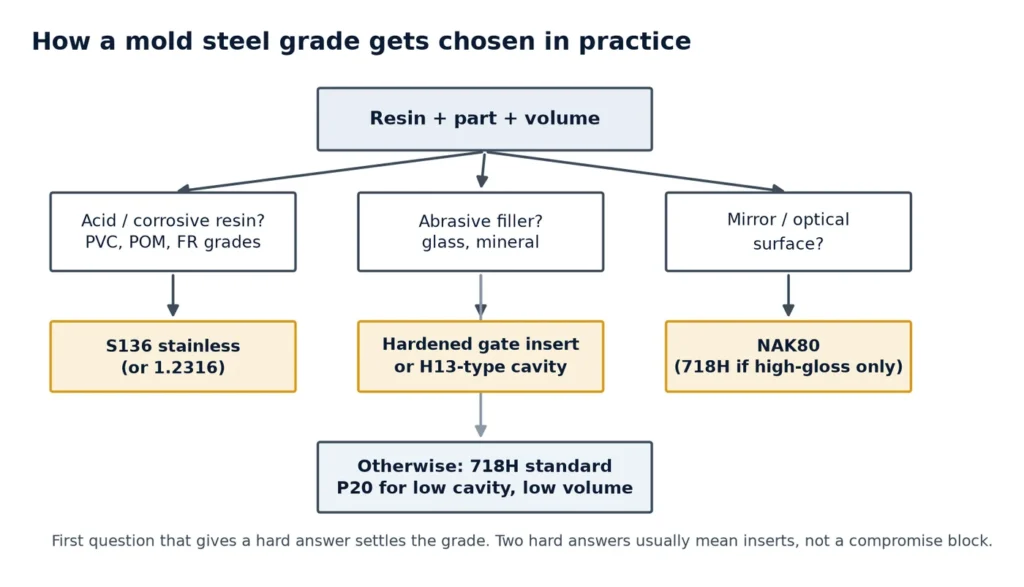
Four questions, asked in this order. The first one that gives a hard answer settles the grade.
- Does the resin release acid or corrode steel? PVC, CPVC, POM, flame-retardant and some medical grades → stainless (S136, or 2316 where polish is secondary). Stop here.
- Is the resin abrasive? Glass or mineral filled, or a highly filled masterbatch → raise hardness. A pre-hardened grade with a nitrided or coated cavity, or a hardened insert at the gate, before considering a full H13 cavity.
- Is the visible surface the product? Class-A paint-free panels, lenses, light guides → NAK80, or 718H where the polish specification is high-gloss rather than optical. At this point the polishing hours, not the steel cost, dominate the risk.
- How many shots? Below roughly 100,000 shots, P20 or 718H is proportionate. Above that, move up the hardness ladder and expect inserts at the gate regardless.
Everything else — block size, insert layout, cooling layout — follows the steel choice, not the other way round. A tool designed around a soft block cannot be upgraded later without re-cutting the cavity — which is why the steel decision belongs in the mold design and engineering stage, not in the purchasing conversation.
Cavity count changes the answer too
More cavities means more of the same failure repeated, and less tolerance for a grade that wears unevenly. It also means the gate area works harder per shot. Cavity count is set by the injection molding volume forecast, so it is worth fixing before the block is ordered.
| Cavity count | Sensible steel position | Watch for |
|---|---|---|
| 1–2 cavities | P20 / 718H; S136 only if the resin demands it | Cheap block, high polish — the two do not coexist |
| 4–8 cavities | 718H standard; NAK80 for visible parts; hardened gate inserts | Uneven cooling shows up as warpage long before the steel wears |
| 16–32 cavities | 718H or NAK80 cavity inserts in a stressed base; H13-type at high volume | Dimensional drift across cavities; spare inserts worth planning from day one |
| 64+ cavities (caps, closures) | Hardened inserts, tight steel specification, controlled heat treatment | Any variation is multiplied; steel certificates and hardness mapping become routine |
How each grade usually fails
Knowing the failure mode is how you justify the grade to a buyer who only sees a block price.
- P20 in a visible part: polishing reveals inclusions and the surface never reaches the spec. The tool is not defective; the grade was wrong for the surface requirement.
- 718H with glass-filled resin: gate wash-out and a polished burnished ring around the gate after a few hundred thousand shots. The fix is a hardened gate insert, fitted at build time.
- S136 with a hot, fast cycle: not a corrosion failure but a thermal one — lower conductivity means the cavity runs hotter for the same cooling, and the cycle or the warpage pays for it.
- NAK80 in a PVC tool: the polish is excellent and the corrosion resistance is not. Stainless is the only answer when the resin is aggressive.
Pre-hardened, through-hardened or nitrided
Pre-hardened means the block arrives at working hardness and is machined directly: fastest route, no distortion, and the reason P20, 718H, S136 and NAK80 cover most tools. Through-hardening (quench and temper after rough machining) buys real hardness for high volume, at the cost of a heat-treat cycle, a finishing allowance and a distortion risk that has to be managed. Nitriding puts a hard skin on a pre-hardened cavity and is a good compromise for abrasive resin at moderate volume — but the skin is thin, and re-polishing removes it.
One practical note from mold making: the hardness number on the certificate matters less than consistency across the block. Two cavities cut from inserts of different hardness will wear differently, and the part quality diverges before anyone notices the steel.
What we need from you before recommending steel
We can propose a grade in one exchange if these six items are on the table:
- Resin and grade (including filler type and percentage, and any flame retardant).
- Required surface: cosmetic class, texture or SPI finish, optical requirement.
- Target production volume for the tool, and whether the tool may be re-cut or re-inserted later.
- Cavity count and expected cycle time.
- Part size and wall thickness — this drives block size and cooling more than the alloy does.
- Any constraint on the tool: existing base to reuse, shipping weight, or a customer steel specification.
With those, the grade, the insert layout and the gate detail follow quickly. If the tool type is still open, the comparison on our mold types page narrows it down before steel is discussed. Without them, any recommendation is a guess dressed up as engineering.
Frequently asked questions
Is NAK80 always better than 718H for a glossy part?
No. NAK80 gives a mirror polish more reliably and holds it through long polishing, which is why it suits optical and high-gloss work. For a painted or textured class-A part at moderate volume, 718H reaches the requirement at lower risk on availability and cost. The decision is the polish specification, not the gloss word.
Can we start with P20 and upgrade the steel later?
Only by re-making the cavity. A soft block that has been cut cannot be turned into a hardened one without re-cutting, and the pocket dimensions are already fixed. If the volume forecast is genuinely uncertain, the practical route is a pre-hardened grade slightly above P20 and inserts at the gate.
Does stainless steel solve sticking and corrosion problems?
It solves the corrosion part and is the right call for PVC, POM and flame-retardant resins. It does not solve sticking: that is a draft, ejection and surface-texture issue. Expect stainless cavities to need the same draft angles as any other steel.
How do we verify the steel we receive?
Ask for the mill certificate with the heat number, check the hardness at several points across the block rather than one, and confirm the analysis matches the grade ordered. On multi-cavity tools, keep the certificates with the tool documentation so a later insert can be matched.
Have a part that needs the right steel?
Send the resin, the surface requirement, the volume forecast and the part drawing. We will come back with the grade, the insert layout and the risks worth designing out before steel is cut.